Certification & Compliance
Certification and compliance begin with the exact facade build-up—not a logo on a brochure.
Starveil maps the proposed system, available evidence and project-specific engineering to the destination market. The quotation then states what we provide, what needs independent testing and what remains with the local project team or authority.
Prepared primarily for architects, facade consultants and contractors. Owners can use the responsibility matrix to identify which local appointments are still required.
Last reviewed: August 2026. Standards and procedures change; confirm current requirements with the appointed local consultant and authority.
01 · Evidence before claims
Four layers must align before a compliance statement means anything.
A material certificate, a laboratory report and a project approval are different documents. We keep them separate so the project team can see the remaining work instead of assuming that one report covers the complete installed facade.
- 01Available evidence
Product and material documents
Manufacturer data, declarations, batch traceability and available source reports for the nominated aluminium, glass, sealant, hardware and finishes. Availability and relevance are checked against the approved procurement schedule.
- 02Applicable after review
Assembly and system evidence
Air, water, structural or other test reports apply to the specimen actually tested. Glass build-up, profile series, span, seals, anchors, dimensions and test pressures must be compared with the proposed project configuration.
- 03Project-specific
Project-specific engineering
Design criteria, wind actions, member and bracket checks, thermal requirements, interfaces and movement strategy are developed for the building. The destination jurisdiction may require review or stamping by a locally licensed professional.
- 04Local team led
Local conformity and approval
Product registration, importer duties, fire review, permit submissions, inspections and final acceptance follow the rules of the country and project. These are led by the appointed local parties unless expressly included in our written scope.
Boundary that applies to every project:
02 · Delivery model changes the interface
The selected site-support route defines who records and closes each step.
Design-supply is our standard international model. Site supervision and managed installation are separately assessed because local licensing, labour, safety, insurance and inspection duties cannot be assumed across borders.
Design-supply + remote support
Starveil provides the quoted engineering, drawings, fabrication, QA records, packing and remote technical response. The client’s appointed local contractor installs and maintains the site records required by its contract.
Design-supply + site supervision
A Starveil or appointed facade engineer supports agreed setting-out, first-panel, interface and inspection activities. Supervision does not transfer the local contractor’s construction, safety, permit or workmanship obligations.
Managed installation route
Considered only for qualified projects after review of local permissions, delivery partners, labour, insurance, safety, programme and commercial risk. T3 is not a standard quotation scope or a general promise of in-country construction.
For the complete workflow, see Approach · Installation support.
03 · Regional reference frameworks
Standards are selected by product scope, jurisdiction and project specification.
The references below are common starting points, not a universal certification list. Editions, test pressures, acceptance criteria and responsible parties must be confirmed by the project’s local consultant and authority.
| Market | Common reference path | What must be verified for the project |
|---|---|---|
| European Union / EEA | EN 13830 curtain walling within the applicable Construction Products Regulation route | Product scope, declared characteristics, applicable conformity route, manufacturer or economic-operator duties and project-specific national requirements. Read the evidence guide. |
| North America | ASTM E283 air, ASTM E331 water, ASTM E330 structural and relevant AAMA 501 / 503 laboratory or field procedures | Specified editions, design and test pressures, specimen size, mock-up or field-test scope, local code requirements and professional sign-off. Review the North American delivery path. |
| Australia / New Zealand | AS/NZS 4284 for representative facade performance testing; AS 2047 where the assembly falls within its window, glazed-door, shopfront or one-piece window-wall scope | Whether the proposed assembly is a curtain wall or fenestration product, nominated test sequence, wind actions, glazing requirements and local certification route. See how evidence applicability is checked. |
| GCC / Middle East | Country- and project-specific building, fire, product-conformity and import requirements; Saudi SASO technical regulations and Saber procedures where the product is in scope | Destination country, HS/product classification, local building and fire authority, importer responsibilities and approved conformity body. G-Mark is category-dependent and is not a universal curtain-wall certificate. See GCC evidence planning. |
Swipe horizontally to see all columns →
Why this wording is deliberate:
04 · Responsibility matrix
Every approval action needs a named owner.
| Workstream | Typical Starveil scope | Typical client / local-team scope |
|---|---|---|
| Design basis | Translate the agreed criteria into the facade proposal and identify missing inputs. | Confirm governing code, authority, loads, fire strategy, energy targets and project specification. |
| Source evidence | Compile available and relevant manufacturer or laboratory documents for the quoted build-up. | Review acceptability with the consultant, authority or approved body before procurement. |
| Project engineering | Prepare calculations and drawings within the contracted design scope. | Arrange local engineer-of-record review, professional stamp or authority submission where required. |
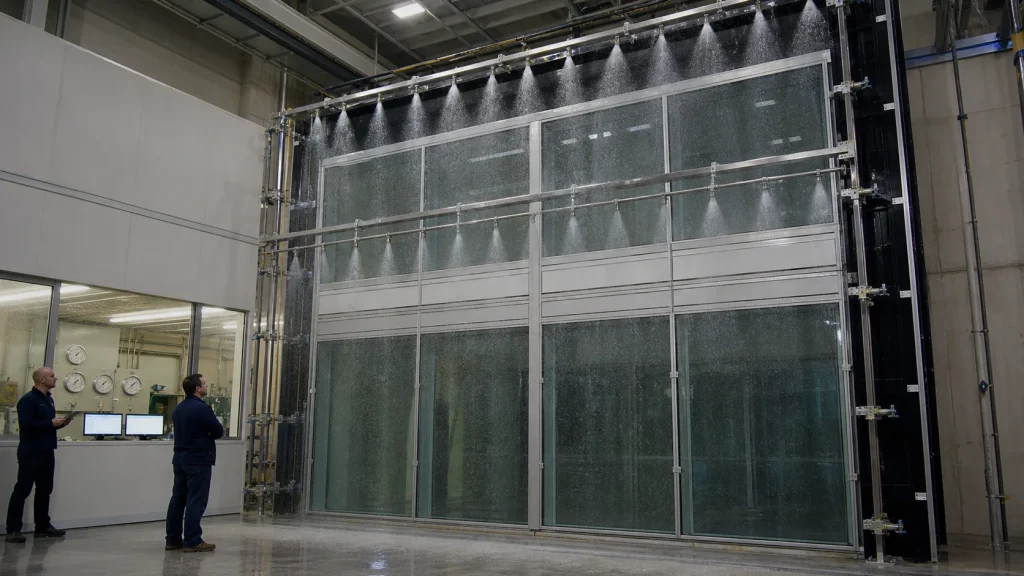
| Mock-up and field testing | Coordinate specimen information, corrective details and records when included. | Appoint or approve the laboratory, witness plan, test pressures, acceptance criteria and site access. |
| Import and product conformity | Provide the agreed export and product documentation available from the supply chain. | Act through the importer or local representative for registrations, customs and market-specific conformity procedures. |
| Installation and close-out | Provide T1, T2 or conditional T3 support exactly as quoted. | Control site safety, readiness, access, permits, inspections and out-of-scope works unless reassigned in writing. |
Swipe horizontally to see all columns →
Material certificates alone do not keep procurement moving.
Procurement begins with material certificates only. During technical review, the consultant requests project-specific structural calculations and a witnessed mock-up. Procurement pauses while the missing evidence and responsibility are resolved. An early evidence matrix identifies that gap before fabrication.
Preparing a specification or tender?
Use the document-package checklist before requesting evidence.
It separates existing source documents from project-specific calculations, tests, approvals and commercial exclusions.
05 · Typical document package
A controlled evidence set—not an unrelated folder of certificates.
The exact package is listed in the proposal and refined after system selection. Documents are issued with their source, revision, applicable configuration and intended reviewer visible.
- Project design basis and responsibility matrix
- Shop drawings, schedules and interface details
- Project-specific calculations within the agreed scope
- Material submittals and available source documentation
- Test-evidence applicability matrix and identified gaps
- Factory QA, traceability and inspection records
- Installation information and agreed T1 / T2 / T3 records
Commercial note:
Further reading: Certifications that matter: what facade evidence does—and does not—prove.
Define the approval path before the facade is fixed.
Send the destination, drawings or photographs, performance specification and known authority requirements. We will identify the first evidence gaps during project review.
3-minute form · no drawings required
No obligation. We follow up only when the project is a clear fit.
